|
|
|
General Information
Francium Isotopes
Natural Occurrence
Application of francium
Chemical-Analytical properties
Separation from other elements
Bibliography
Other web references to francium
| 1. | General Information | ||||||||||||||||||||||||
| As early as 1870, Mendeleev predicted that it should be possible to find an element with atomic number 87 in nature. This element should occupy a place in the Periodic Table in the first group of the tenth series [group 1 in the new nomenclature] and should have an atomic weight of between 210 and 230. The element should form an oxide of the type Me2O and be an analogue of caesium(Cs). Thus, it would be the heaviest alkali [Group 1] metal. The first news of the [later found to be erroneous] "detection" of element87 appeared in 1925. Up until 1937, numerous chemists searched for this element in different natural objects, minerals, cigar ash, straw, mushrooms, beet molasses, sea water and mineral waters. Different physical methods were used : magneto-optical, X-ray and cathode ray analysis. However, none of these methods gave convincing proof that element 87 exists in nature. Later, the reasons for the failure of the search were understood; element 87 has neither stable nor long-lived radioactive isotopes.
Radiometric methods gave better results. After the radioactive decay series of 235U, 238U and 232Th with stable lead as end-products had been studied, it was assumed that radioisotopes of element 87 exist as intermediate members of these decay series. As early as 1914, Meyer, Hessand Paneth studied a carefully purified 227Ac preparation and observed a-particleswith a range of 3.5cm, which they attributed to element 87. In 1939, Mme. Marguerite Perey, of the Curie Institute in Paris, thoroughly studied a-particlesof the same range in the decay of a radioactive 227Ac sample,and found a daughter b--active decay product with T1/2=21 min. The chemical properties of thisproduct were close to those of caesium. Thus, for example, the b--activity remained completely in the filtrate after precipitation of BaCO3, lead and bismuth sulphides and lanthanum hydroxide and fluorides, but passed quantitively into a caesium prechlorate precipitate. It was thus establishedthat this is an isotope of element 87 with mass 223. This isotope was originally designated as "Actinium-K" (Ac-K), along with other decay products of actinium. In 1946, Mlle. Perey termed this element francium (in honour of her native France) and in 1949, the IUC (International Union of Chemists) adopted this name and assigned the symbol Fr to the new element. Of the first 101 chemical elements, francium is the most unstable. The closest to it is astatine (At), which has a maximum T1/2 = 8½ hours. |
|||||||||||||||||||||||||
| 2. | Francium Isotopes | ||||||||||||||||||||||||
Currently (early 2000), there are 34 identified Francium isotopes (according to the CRC Handbook of Chemistry,1999-2000). Some of these with atomic masses of from 204 to 213 (with the exception of 212) were found as late as 1964, with the lowest and highest values of A found between 1964 and 2000. The francium isotopes with thelongest half-lives are 223Fr (T1/2 = 22 mins) and212Fr (T1/2 = 20 mins). A detailed analysis of theradioactive properties of the francium isotopes proved that there is noreason to expect new isotopes with longer half-lives. As predicted (byA.K.Lavrukhina, 1958), all the francium isotopes with masses £213 have been obtained in nuclear reactions with multiple charged ions:
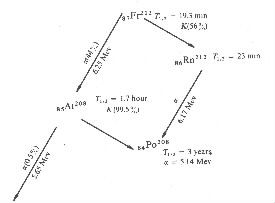
The appearance of the comparatively long-lived212Fr amongst the shorter-lived francium isotopes is not accidental,but is a logical consequence of the regular properties of the a-active isotopes of heavier elements according to which the value of Eain the isotopes of one element increases linearly with decrease in massnumber A. This dependence departs from linearity only near nuclei thathave a filled shell of 126 neutrons; q.v. Fig 1. Fig 1 Dependence of the energy of a-decayin Fr The existence of a francium isotope witha neutron number of 125 (equating to 212Fr) was assumed, with Ea minimalcompared to the neighboring isotopes. This isotope was found in the productsof thorium irradiated by 350MeV protons. 212Fr with Ea approx. = 6.4 MeV and T1/2 =19.3 minutes was found in 1950. The main source for the preparation ofthis isotope is products of the fission of Th and U by high energy protons. Fig 2 Cross-section of formation of Fr and neighbouring elements The cross-sections of formation of thefrancium isotopes £220 during the fissioning of uranium nuclei by 660 MeV protons have been calculated (Fig 2), and 220Fr should have the maximum yield (just under 10 mbarns). The cross-section of 212Fris comparatively low, at 0.2 mbarns. When thorium nuclei are fissioned,the cross-section of formation of 212Fr should be higher. Ahigher yield of 212Fr is attained in the reaction 197Au(22Ne;a,3n)Fr212.The decay scheme of 212Fr is shown in Fig 3. Fig 3 Decay scheme of 212Fr In accordance with the pattern of a-decaythe isotopes with a neutron number (N) of 128 have the shortest half-lifeand the highest Ea.215Fr is such an isotope (Fig 1). The twojuxtaposed isotopes 214Fr and 216Fr are also short-livedcompared to isotopes with A £213 and A ³217. For isotopes with A between 215 and 221, function Eais linear, Fig 1; hence, the half-lives also increase.The isotope 222Fr is the lightest b--activity francium isotope. An almost complete list of knownisotopes (there are allegedly 34 as at 2000) with their associated atomic weights and half-lives is shown in Fig 4. N (thenumber of neutrons) may be obtained by subtracting 87 from the isotopenumber, #. In this table:
Note that different sources state different numbers of isotopes; I shall try and list as many as I can glean from thosesources. In any case, the only 'natural' isotope of Francium found in nature is 223Fr which is part of the actinium decay series. 221Fr is part of the neptunium decay series, but this tends not to be 'natural'.
Fig 4 Summary of Francium isotopes All the isotopes with masses ³215 were obtained by fissioning U or Th nuclei with fast particles. The cross-sections of formation of these isotopes are between 1 and 7 mbarnswhen U is fissioned with 660 MeV protons. The isotope 223Fr has been themost exhaustively studied. Its decay scheme is shown in fig 5. Possiblea-decay of 223Fr with an energy of 5.5 ± 0.2 MeV was predicted from the empirical laws for a-activeisotopes; the probability is between 6 x 10⁻⁴ and 4 x 10⁻⁵of the b--decay. By means of high-speed photographic plates, a-particles with an energy of 5.38 ± 0.08 MeV were observed in the decay of223Fr. The ratio a/bwas 6 x 10⁻⁵. 227Ac is the main source of223Fr, formed as the result of the a-decay of 227Ac; the a-decay is 1.2% of the b--decay.The 227Ac preparations are obtained either by the waste productsof the uranium industry or by irradiating 226Ra in a nuclearreactor by the reaction:
Note that the reported number (and details) of francium isotopes varies greatly with source, hence the caveat on the number of actual isotopes that exist or have been created. |
|||||||||||||||||||||||||
| 3. | Natural occurrence | ||||||||||||||||||||||||
Detailed studies on the decay products of natural radioelements showed that the francium isotopes are the intermediate members of certain series. Thus, 223Fris a member of the actinium-uranium series (i.e., a parent of 238U).One tonne (1.0 t) of unimpaired natural uranium contains:As early as 1940, it was assumed that isotope 221Fr is a member of the neptunium series (4n + 1). When the decay products of 233U obtained by irradiating thorium with thermal neutrons were studied, this isotope was separated. Since the amount of 237Np in uranium ores is known,the equilibrium amount of 221Fr can be estimated; it is approximately: 221Fr¾®1.0 x 10⁻¹⁷g / tonne of natural uraniumThe short-lived isotope 224Fr is a member of the thorium series. In the earth's crust as a whole, at anygiven time there is probably only 25 - 30g of francium. This amount is, of course, distributed throughout the crust and represents the amount in equilibrium with its host ore. As can be seen from the above figures, the amount in any one place is miniscule. As such, it competes only with astatine for the accolade of being the rarest of the 92 naturally-occurring elements. No weighable amounts of francium have ever been produced, nor are ever likely to be, due to its extreme transient nature. Radiometric studies of francium have been undertaken with samples of the order 10-9 g in weight. | |||||||||||||||||||||||||
| 4. | Application of francium | ||||||||||||||||||||||||
| In spite of its short life, francium has been applied in practice to the determination of actinium in natural objects.Formally, these determinations were carried out by measuring the activitiesof all the 227Ac decay products after three months,when equilibrium had been established. Mme. Perey developed a very fastmethod for determining actinium from the daughter francium. Francium is separated from actinium three hours after the latter has been isolatedfrom natural products, and the b--activityof 223Fr is measured. With this method it is possible to determine actinium with sufficient accuracy in the presence of other radioactive elements. 223Fr has been usedin limited biological research. In the study of the distribution of Fr, Rb and Cs in different organs of rats, it was found that the alkali metals accumulate chiefly in the kidneys, liver and salivary glands. It was shown that Fr is also fixed in an experimentally-induced sarcoma. Increase in the activity of Fr in the affected tissue appears immediately after onsetof growth. This diagnostic method for cancerous diseases could be promising as there is no [little?] damage to the organism because of the short lifetime of either 223Fr or 212Fr. Apart from these applications, there is no commercial application of francium, due to its transient nature. | |||||||||||||||||||||||||
| 5. | Chemical-Analytical properties of francium & its compounds | ||||||||||||||||||||||||
| Melting point -> 27.2ºC (300.2 K).Hence would be borderline liquid at room temperature. Boiling point -> 677ºC (950 K) Francium, in the same way as other alkalimetals, has no tendency to form complexes or colloids. The adsorptionalproperties of Fr+ have not been studied because of the shortlife of its isotopes. In analogy to Cs+, whose adsorptionon glass, Teflon and polyethylene has been studied in detail, it can beassumed that the adsorption of Fr+ on these surfaces from aqueoussolutions at pH 4 thru 11 will be insignificant. It has also been provedthat the adsorption of 137Cs on a polypropylene surface is considerablyless than on glass or Pyrex. It would appear that francium has similarproperties. In contrast to many artificial elements(Pu, Np, Tc, Pm et al), francium cannot ever be obtained in weighable amountsdue to there being no long-lived isotopes thereof. Hence, all the chemical and physical properties of francium have been studied with extremely low amounts, typically £10-15g. Given its position in the Periodic Table, francium is expected to be the most electropositive element, continuing the procession down the Group 1 line from Li to Cs. Francium exists in just one oxidationstate, +1. Data on analysis of francium suggest that it is a complete analogue of Rb and Cs; in other words, many of its properties can be inferred from properties of those two elements. As time goes on, these properties are duly verified. The chloride, nitrate, sulfate, fluoride, sulfide, hydroxide, carbonate, acetate and oxalate of francium would be readily soluble in water, but the perchlorate, picrate, iodate, and some salts (such as Fr9Bi2I9)would be sparingly soluble. According to its position, francium should have a more negative standard potential than caesium (where E0= -3.04 V). Therefore, francium can be separated on mercury only. However,very dilute amalgams are unstable; amalgams formed from 10-9M 137Cs show this. Attempts to obtain similar results for 10-14M francium were unsuccessful even when ultra-pure reagents were used. The francium amalgam decomposes a few minutes after the current isturned off. The amount of francium that passes into mercury at a given potential is less than that of caesium; this proves that francium is separated at a more negative potential than caesium. | |||||||||||||||||||||||||
| 6. | Separation of francium from accompanying elements | ||||||||||||||||||||||||
| The separation of the alkali metals isone of the hardest analytical problems to solve. For francium, the problemis compounded by its very short half-life. It is difficult to separatethe heavier alkali elements (Rb, Cs and Fr) because their ionic radii are close to each other. The problem of separating francium from other alkali elements frequently arises in the analysis of products ofdifferent nuclear reactions. In the analysis of natural objects 227Acis separated from the main components and then from its decay products.223Fr is separated from 227Ac after radioactive equilibriumhas been established, typically about 2 hours. There are several documented ways to extractfrancium; these include extraction, sublimation and ion exchange. Theseprocesses are far too detailed to go into here, but the book in the biblographydetails them. However, a lab at Stony Brook has perfected a technique tocapture 10,000 francium atoms at once. For more information, check outtheir link. | |||||||||||||||||||||||||
| 7. | Bibliography | ||||||||||||||||||||||||
| Much of the information comes from the out-of-print book "Analytical Chemistry of Technetium,Promethium, Astatine and Francium". by A.K.Lavrukhina and A.A.Pozdnyakon, AnnArbor-Humphrey Science Publishers Inc., 1970. Other information gleanedfrom reference works and own research. | |||||||||||||||||||||||||
| 8. | Otherweb references to francium | ||||||||||||||||||||||||
| The following are some other links onthe web to Francium: WebElements
This page is now complete! I would onlyneed to add extra information as it comes along, such as more isotopes.Keep checking back for the latest update. Some weird format changes occurred 23 Aug 2011 when I was able to restore the background image and the other images on the page - these I will fix in due time (mainly words got joined together). |
Visitors so far:  (since 4 Oct 1999)
This page is best viewed using Internet Explorer 7 (or above).
Not using this? Download one now - Explorer/ .
Download my FREE Crossword/Word Puzzle Utility - Click Here!!
| [General | Isotopes | Nature| Apps | Analysis |Separation | References |Top ] |